The Five Building Types in New York and What They Mean for Design
In the New York residential market, the building is the primary constraint. Before a single material is specified or a layout is proposed, the architectural DNA of the structure dictates the limits of what is possible, what is permitted, and what is economically viable. For the professional designer, understanding New York’s building typologies is not just a matter of historical interest; it is the fundamental framework for technical specification and project management.
This guide establishes the studio’s five-type framework for classifying New York residential buildings: Pre-War Co-op, Post-War Co-op, Glass Tower, Townhouse, and Loft. Each type carries a distinct set of structural, mechanical, and administrative parameters that must be audited before design development begins.
1. Pre-War Co-op (1880s – 1940)
The pre-war co-op is the foundational typology of Manhattan’s luxury market. Built primarily with load-bearing masonry and structural steel, these buildings represent a specific era of craft and a specific set of technical challenges.
Structural Characteristics
Pre-war apartments are defined by high ceilings (typically 9’ to 11’+), thick plaster-over-lathe walls, and solid masonry partitions. Unlike modern construction, the "bones" are heavy and acoustic separation is naturally superior due to the mass of the materials.
Design Implications
- Ceiling Heights: While high, ceilings often conceal complex structural beams. Reconfiguring layouts often reveals unexpected "drops" that must be integrated into the architecture.
- Plaster Walls: Every wall is a permanent intervention. Chasing new electrical or plumbing through plaster is labor-intensive and requires specialized trade knowledge.
- Flooring: Typically white oak or maple in herringbone or strip patterns. These floors are often integrated into the subfloor assembly, making replacement a structural consideration.
2. Post-War Co-op (1945 – 1980s)
Post-war buildings were optimized for efficiency and volume. Often characterized by the "white brick" facade or simple red brick envelopes, these structures introduced the reinforced concrete slab system to the residential market.
Structural Characteristics
Poured-in-place concrete slabs allowed for thinner floor assemblies and lower ceiling heights (typically 8’ to 8’6”). Instead of load-bearing interior walls, these buildings utilize a column-and-slab system, allowing for more flexible internal layout changes—provided you don't hit a structural column.
Design Implications
- Ceiling Constraints: There is rarely enough "dead space" to recessed lighting. Design solutions often involve soffits, surface-mounted fixtures, or integrated millwork lighting programs.
- Acoustics: Concrete slabs transfer impact noise more readily than pre-war masonry. Specifying high-performance acoustic underlayment is non-negotiable in this typology.
- Window Walls: These buildings often feature larger horizontal window spans than pre-war types, requiring specific drapery and light control strategies.
3. The Glass Tower (1990s – Present)
The modern glass tower represents the shift toward transparency, open plans, and "curtain wall" technology. These are the "new construction" landmarks that define the contemporary skyline.
Structural Characteristics
The envelope is typically a non-structural glass curtain wall. The interior is a wide-span concrete system with minimal internal columns, designed to prioritize floor-to-ceiling views.
Design Implications
- The Curtain Wall Boundary: You cannot touch the glass. All interior millwork and partitions must "float" or interface with the facade through specific gasketed details.
- Light Management: The primary challenge is heat gain and UV protection. Motorized shading systems are a standard specification, often integrated into the building's automation system.
- Open Floor Plans: Without internal walls, the designer must use furniture, flooring transitions, and ceiling treatments to define "rooms" without closing them off.
4. The Townhouse (Mid-1800s – Present)
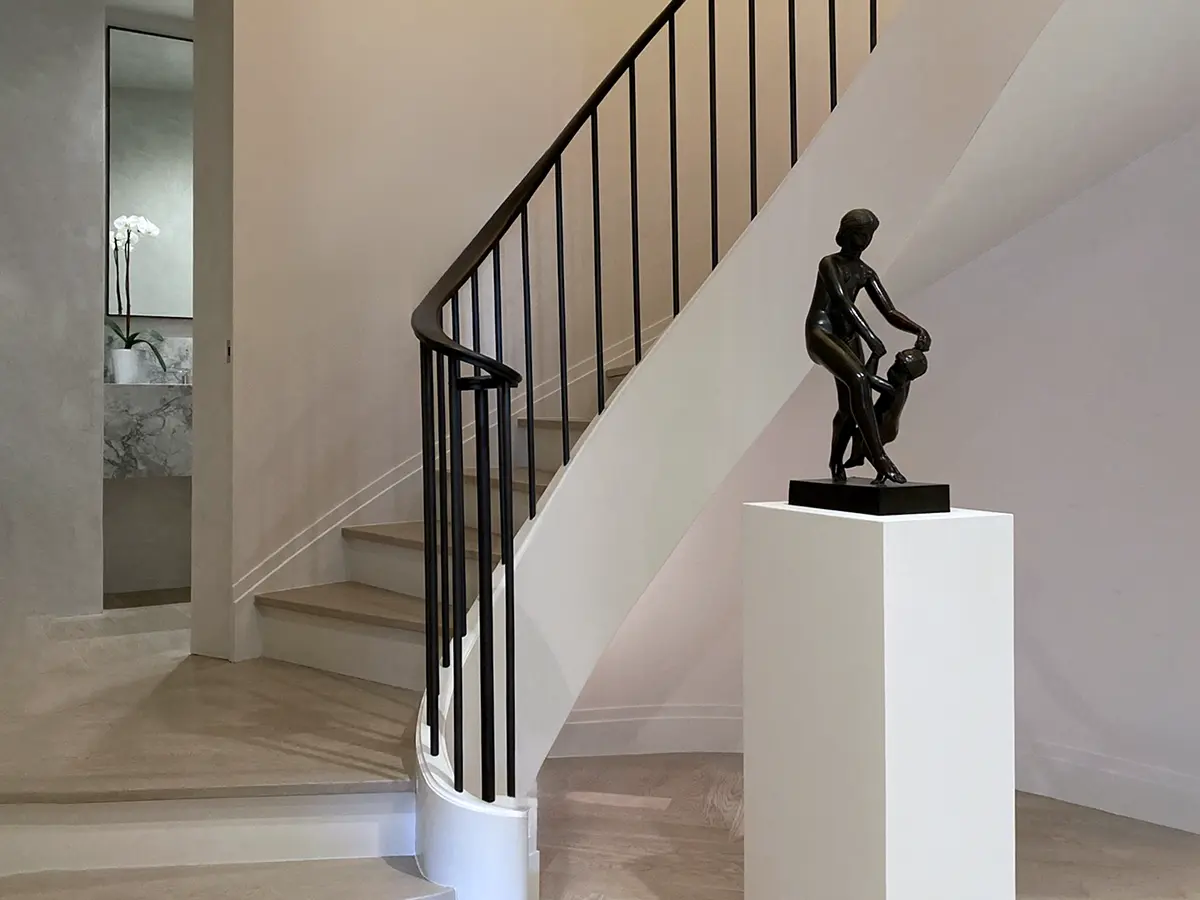
The townhouse (or brownstone) is New York’s only vertical typology. Whether a single-family mansion or a multi-unit conversion, the townhouse operates within a strict vertical hierarchy.
Structural Characteristics
Masonry party walls on the sides with timber joist floor systems spanning across. These buildings are narrow (typically 16’ to 25’ wide) and deep (up to 60’+), creates a "dark center" problem.
Design Implications
- Vertical Circulation: The stair is the architectural engine of the house. It is often the most significant design element and the most complex to renovate.
- Natural Light: Designers must utilize skylights, rear-window expansions, and open central voids to pull light into the core of the building.
- Floor Assignments: Each floor carries a distinct "register." The parlor floor is ceremonial; the garden floor is functional; the upper floors are private. Design must respect this hierarchy.
5. The Loft (Industrial Conversions)
Primarily found in SoHo, Tribeca, and Chelsea, lofts are former industrial or commercial spaces converted to residential use. They offer a scale and volume unique to the city.
Structural Characteristics
Heavy timber frames or cast-iron columns with massive floor loads. High ceilings (12’ to 15’+) and oversized window openings are standard.
Design Implications
- Zoning within Openness: The challenge is creating intimate "human scale" spaces within a cavernous volume. Millwork often takes on the role of architecture, creating "islands" of function.
- Industrial Register: The design must navigate the balance between the "rough" industrial shell and the "refined" residential program. Exposing structural elements like cast iron or brick requires careful coordination with MEP (Mechanical, Electrical, Plumbing) systems.
- Service Core Architecture: Bathrooms and kitchens are often clustered in a central "service core" to maintain the openness of the main living areas.
Technical Audit: The Starting Point
For every project, the studio conducts a Building Typology Audit. We evaluate:
- Slab-to-Slab Dimensions: Absolute vertical limits.
- Board Process: The specific "Alteration Agreement" constraints (seasonal work windows, insurance requirements).
- MEP Infrastructure: The building's capacity for HVAC, electrical upgrades, and plumbing wet-over-dry restrictions.
Understanding these five types allows a designer to transition from "making things look good" to designing within the technical reality of New York.
The Designer’s Role
A professional designer does not fight the building; they utilize its inherent logic. A pre-war apartment should feel grounded and composed; a glass tower should feel airy and connected to the horizon; a loft should celebrate its volume.
Ready to discuss your project?
If you are planning a renovation or decoration program in one of New York’s iconic building types, we invite you to start a conversation about how we can navigate the technical and design complexity together.
Start a Project
Bring this into your home.
Our studio works with a select number of clients each season. If you're ready to begin, we'd love to hear about your space.
Begin Your Inquiry